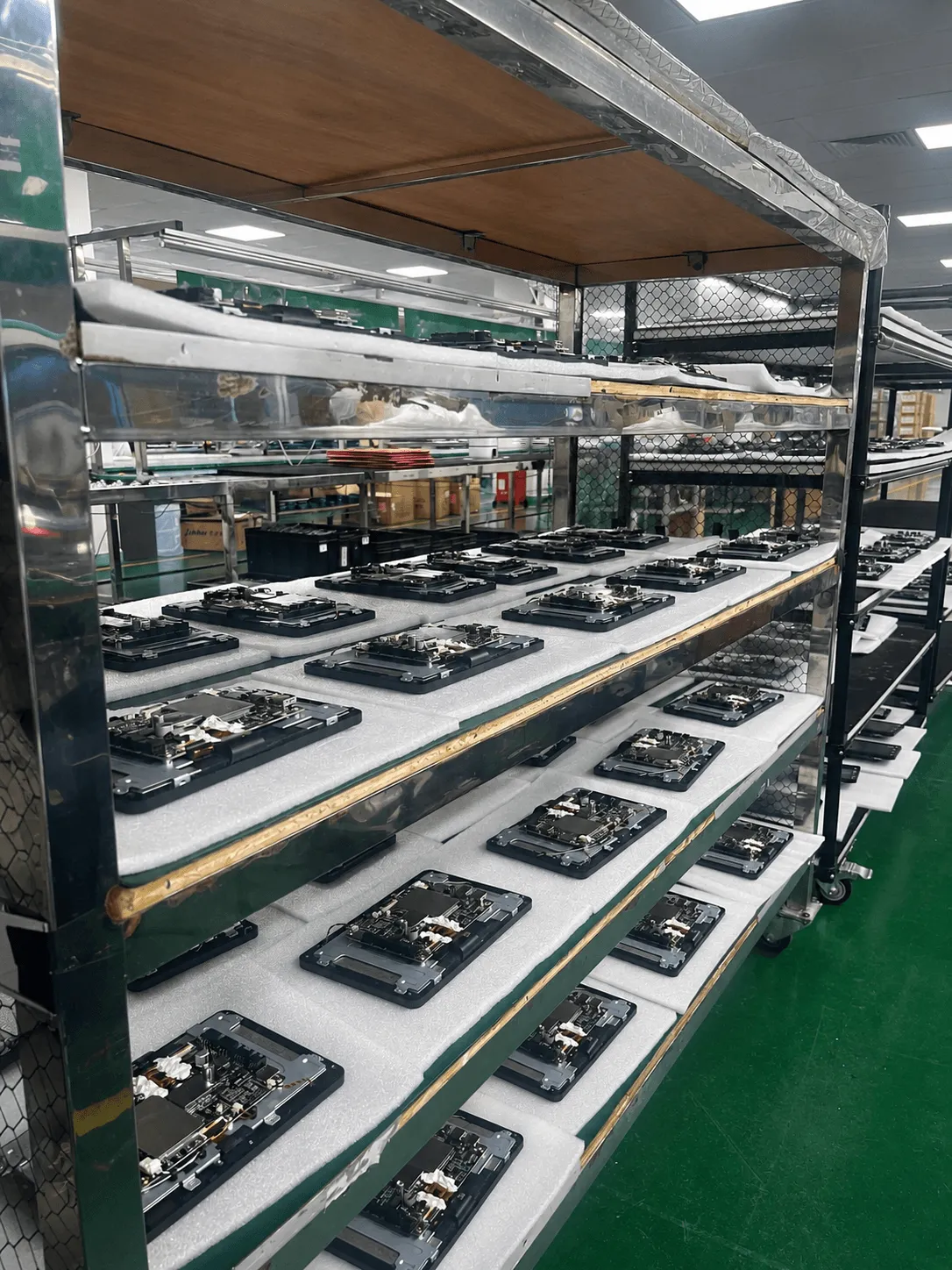
How do I buy samples of a PDS vehicle tablet?
Contact the sales team through the form on this site, by email at [email protected], or by phone or WhatsApp on +86 13717134343. Name the model, the operating system build and any options — RTK module, expansion set, camera count — because a sample built to your configuration teaches you far more than a stock unit. Sample price and timing are confirmed for the configuration you choose.
Which operating system should I choose, Android or Linux?
Choose by the software you already own. Dispatch, telematics and fleet applications point to Android, which spans the range from Android 10 to Android 13. Machine-control software, especially existing QT builds, points to Linux, offered on the T7, T10, T10B and T12. The size guide and platform comparison on this site walk the decision in full; the short version is that one operating system per fleet role keeps support sane.
Can these terminals really give centimetre-level positioning?
With the right system around them, yes — that is what the RTK options are for. The terminal hosts an RTK-capable UNICORE module, receives correction data by mobile network or by radio from a local base, and uses a survey antenna with open sky. The T10 Pro lists a radio module for corrections beyond 4G coverage. Standard GNSS without corrections stays at metre level, which is fine for mapping and logging but not for steering.
What is the minimum order quantity and lead time?
Confirm both with the sales team for your model and configuration. They depend on the model, the options fitted and the programme — standard fleet order, or OEM/ODM build — so this site does not print a single figure that would be wrong for half the catalogue. The same applies to delivery scheduling for large rollouts, which is agreed around your vehicles' downtime windows.
What warranty do the terminals carry?
The company's About page describes a standard warranty of 1 year, with an option to extend to 3 years. Warranty handling in your country — where a unit is sent, and what turnaround to expect — is a confirmation item for the enquiry, because it depends on the sales channel and configuration. Ask for the warranty terms in writing with your quotation.
Can PDS build a terminal under our own brand?
Yes — that is the OEM and ODM programme. OEM puts your design, logo and packaging into PDS production; ODM co-develops hardware, firmware and operating system builds around the standard platforms, with custom interfaces and mounting. Bring volumes, target market and must-have interfaces to the first conversation; programme scope, minimum quantities and schedules are agreed per project.
Which certificates can you provide for our market?
The company documents a National High-Tech Enterprise Certificate (GR202544204396) and a technology-based SME registration (2025440306A0006011) with certificate images, and states management systems including ISO 9001, IATF 16949 and BSCI. Product-level material published by the company includes E-Mark and CE names and an IP66 test report for the T10 family. Ask for current certificate and test copies for your exact model and market when you enquire; certificates are available upon request.
Will a PDS terminal work on both 12 V and 24 V vehicles?
The T-series specification is a 9-36 V DC input with ISO 7637-II behaviour, which is designed to cover 12 V and 24 V vehicle systems and the cranking dips and load behaviour between them. Electric forklifts and special vehicles can behave differently; name the exact vehicle power in your enquiry so the fit is confirmed rather than assumed.
How do the terminals connect to our machines and platform?
By the interfaces in each model's specification: CAN bus for machine and implement data, RS232 and RS485 for controllers and sensors, Ethernet for data-heavy links, and camera inputs where fitted. Expansion combinations are build options — the T10 family, for instance, runs to four cameras, dual CAN and dual RS232 in its largest set — so the exact combination for your build is confirmed in the quotation, together with connector and cable details.
What happens if our region has poor mobile coverage?
Positioning does not depend on the mobile network; correction data is the part that can. Where network RTK is unreliable, the T10 Pro's listed radio module receives corrections from a local base station in the 410-470 MHz band. Terminals also keep working offline for guidance and logging, syncing when coverage returns. Describe your operating region in the enquiry so the correction path is designed in from the start.
A question this page does not answer
Send it with the enquiry form, together with your vehicle type and software. Configuration questions — expansion sets, RTK modules, operating system builds — get exact answers per model from the sales team, and minimum order quantities and lead times are confirmed for your configuration in the same reply.
Ask about your unanswered terminal question
Send your vehicle, software and interface list. The sales team replies with a configuration and price.