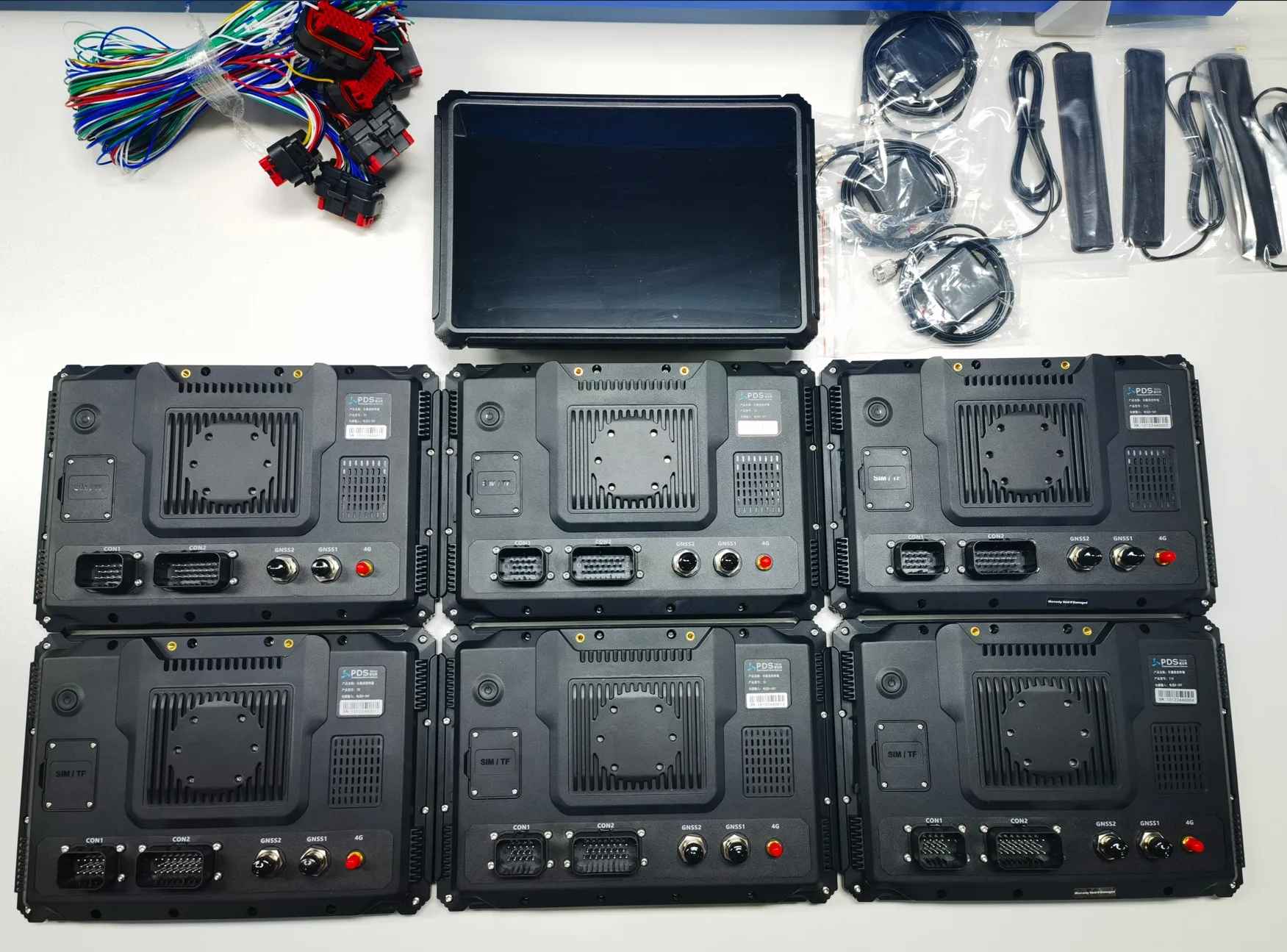
R10: what the company publishes
What is confirmed
The company's Chinese site describes the R10 as a rugged handheld tablet computer; its AgriExpo stand lists the R10 as a Linux/Android tablet with a 10.1-inch screen, Android 11 and an Arm Cortex-A53 quad-core processor; the DirectIndustry stand lists it as a rugged tablet.
What is not published
No standalone specification page for the R10 was published on the company sites checked for this catalogue: protection rating, battery, weight and the full interface set are not stated there, and this page does not fill those gaps with guesses.
How a handheld rugged tablet earns its place beside a mounted terminal
Mounted terminals serve the driver; a handheld rugged tablet serves everyone else in the operation. Supervisors walk the yard with it, technicians use it during installation and diagnostics, agronomists carry it between machines when a guidance system needs checking in the field. That mix of indoor and outdoor work is why buyers evaluate a handheld differently: screen readability in sun, a housing that survives being set down on steel and concrete, and an operating system the same support team already manages. The R10 sits in the PDS range as that portable member of the family, alongside the mounted T-series rather than instead of it.
Questions to settle before you order the R10
Because the published material for the R10 is short, the enquiry conversation carries more weight than usual. Ask for the current full specification sheet, the protection rating and drop-test basis, battery capacity and shift-life expectations, charging and dock options, and the exact Android or Linux build offered. Confirm which of your existing applications run on it, whether a vehicle dock is available for the machines it will ride in, and how warranty and repair are handled in your country. A short written answer to those points is worth more than a long brochure, and the sales team can supply the sheet on request.
- Current full R10 specification sheet and protection rating
- Battery size and realistic shift life in your application
- Android or Linux build offered, and your app compatibility
- Vehicle dock and charging options
- Warranty terms and repair route for your country
- Sample availability for a field trial
How the R10 fits the wider PDS system
Within the wider PDS system, the R10 is the terminal that leaves the vehicle. The mounted T-series units are wired, bracketed and assigned to one machine each; the R10 is carried between machines, into the yard and onto the bench. That role makes it the natural companion for installation crews fitting the mounted range, for supervisors checking guidance and dispatch work in the field, and for agronomy and maintenance staff whose workplace is the fleet rather than a cab. Buyers usually evaluate it alongside the mounted unit it will support — same operating system family where possible, so one software image and one support routine cover both the fixed and the carried screens in the operation.
It also changes the support conversation in a useful way. A mounted terminal that misbehaves takes a machine out of work; a handheld can be swapped, charged and diagnosed on the bench. Fleets that adopt a carried rugged tablet typically hold it as shared equipment — signed out per shift or per job — which makes battery behaviour, charging docks and loss discipline part of the specification to confirm. Ask the sales team how the R10 is charged, docked and carried, what cases or straps are offered, and how a damaged unit is repaired or replaced under the company's standard warranty terms. Those operational answers, plus the full specification sheet, complete the picture the published pages begin.
Ask about the R10 for your fleet
Send your vehicle, software and interface list. The sales team replies with a configuration and price.