The five places consumer tablets fail in vehicles
Start with power: a consumer tablet runs on a battery and a USB charger, and vehicles kill both — vibration works connectors loose, heat ages cells, and a device that starts the day at 40% starts the argument by noon. Light comes second: consumer panels are specified for offices, and at midday in a glass cab they wash out exactly when guidance matters. Third is sealing — one harvest's dust or one pressure wash ends an unsealed device. Fourth is connection: a consumer tablet has no CAN, no RS232, no camera inputs, so the machine conversation needs adapters that fail in creative ways. Fifth is lifecycle: consumer models change yearly, breaking mounts, cases and software images across a fleet.
Where the consumer tablet still wins, honestly
For a single vehicle, a light-duty application and a buyer who can tolerate replacement as the maintenance plan, a consumer tablet in a good powered mount is a rational purchase — the unit price is real money saved. The crossover comes with fleet size, duty severity and integration depth. Once the tablet must talk to the machine, survive the workplace and stay identical across thirty vehicles and three years, the rugged vehicle's total cost — purchase, mounting, downtime, replacements, support — undercuts the cheap device decisively. The rugged premium buys engineering aimed at the failure list: 9-36 V direct power, IP66-class sealing, 750 cd/m2 panels, machine interfaces and a stable configuration.
- Power: battery and USB vs direct 9-36 V vehicle supply
- Light: office brightness vs 750 cd/m2 sunlight-readable panels
- Sealing: unsealed vs IP66 against dust and wash-down
- Interfaces: USB only vs CAN, serial, Ethernet and cameras
- Lifecycle: yearly model churn vs stable fleet configuration
- Mounting: clamps and cases vs engineered vehicle brackets
The rugged side of the comparison
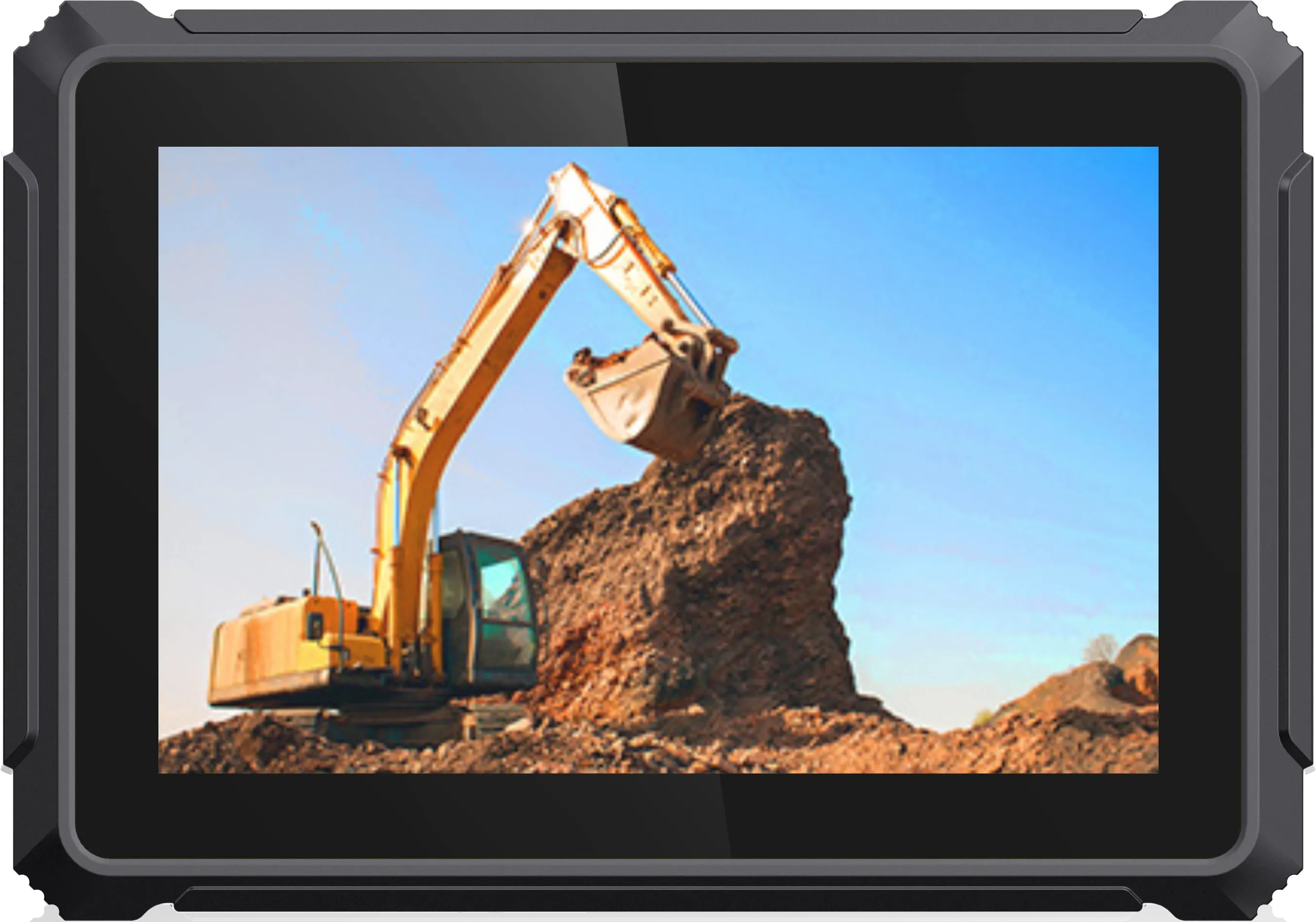
For in-cab computing, the T8 brings a 8" IPS, 1280 x 800, brightness 750 cd/m2 or higher, fully laminated multi-touch and runs Android 10.0 on 64-bit quad-core Cortex-A53 at 1.5 GHz. Its positioning fit is GPS + BeiDou module (N303-5Q); optional built-in centimetre-level RTK positioning module (module model not stated on the product page), and the interface side reads: 23-pin function expansion port; standard expansion set of 1 x camera, 1 x CAN, 1 x RS485, 1 x 100M Ethernet plus power/ACC. That is why it appears in this shortlist: the combination matches the data and connections this work actually uses, in a housing specified for 9-36 V DC input (ISO 7637-II); IP66 sealing; operating temperature -20 to +70 C; MIL-STD-810 and ISO 16750 testing.
For in-cab computing, the T10 brings a 10.1" IPS, 1280 x 800, brightness 750 cd/m2 or higher, fully laminated multi-touch and runs Android 10.0, or Linux kernel 4.9 with QT 5.12 (optional) on 64-bit quad-core Cortex-A53 at 1.5 GHz. Its positioning fit is GPS + BeiDou module (optional fit); RTK module UM482 or UB482 (optional), and the interface side reads: 14PIN connector x1 and 23PIN connector x1, both function extension interfaces; default function set of 4 x camera, 2 x CAN, 2 x RS232 and 1 x 100M Ethernet. That is why it appears in this shortlist: the combination matches the data and connections this work actually uses, in a housing specified for 9-36 V DC input (ISO 7637-II); IP66 sealing; operating temperature -20 to +70 C.
Running the comparison for your fleet
Cost both options over the fleet's life, including mounts, replacements and one downtime incident per vehicle per year on the consumer side. The arithmetic usually settles the argument without rhetoric. If it settles on rugged, send your vehicle list and software to the sales team and confirm configuration, minimum order quantities and lead times.
Ask about a rugged alternative for your cab tablets
Send your vehicle, software and interface list. The sales team replies with a configuration and price.