What precision agriculture asks of a cab terminal
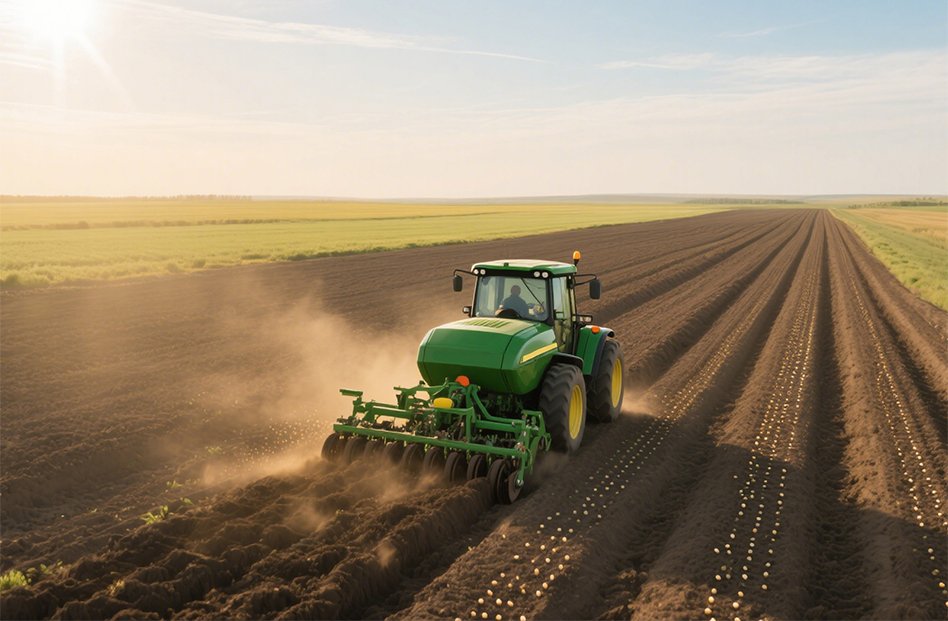
Precision agriculture turns the cab terminal into the farm's control surface: it steers or guides the tractor, meters seed and spray, records what was applied where, and keeps working through dust, vibration and twelve-hour days at planting and harvest. That workload explains the shape of the PDS range — sunlight-readable screens, sealed housings (IP66 in each model's specification) against field dust and wash-down, wide-voltage power that survives cranking, and RTK GNSS options for the passes that must repeat within centimetres. The company's application pages describe its terminals across seeding, spraying and auto-steering work, including a smart spraying system built around its 10-inch computer.
Matching the terminal to the field job
Guidance-only work on a compact tractor can live on the T7, whose front keys suit a driver who works by feel. Implement control — seeding and spraying controllers that talk to the machine over CAN while showing rates and sections — belongs on the 10-inch models, whose expansion combinations carry the camera, CAN and serial channels those systems need. Large modern cabs running split screens graduate to the T12. In every case the positioning decision comes with the terminal decision: standard GNSS for mapping and logging, an RTK module and roof antenna for repeatable passes.
- Guidance and auto-steering displays from 7 to 12.1 inches
- Seeding and spraying control over CAN with section and rate data
- RTK module options for repeatable, centimetre-level passes
- IP66 sealing specified per model for dust, chaff and pressure washing
- Camera inputs for implement and hopper monitoring
The terminals precision agriculture usually picks
For precision agriculture field work, the T10 brings a 10.1" IPS, 1280 x 800, brightness 750 cd/m2 or higher, fully laminated multi-touch and runs Android 10.0, or Linux kernel 4.9 with QT 5.12 (optional) on 64-bit quad-core Cortex-A53 at 1.5 GHz. Its positioning fit is GPS + BeiDou module (optional fit); RTK module UM482 or UB482 (optional), and the interface side reads: 14PIN connector x1 and 23PIN connector x1, both function extension interfaces; default function set of 4 x camera, 2 x CAN, 2 x RS232 and 1 x 100M Ethernet. That is why it appears in this shortlist: the combination matches the data and connections this work actually uses, in a housing specified for 9-36 V DC input (ISO 7637-II); IP66 sealing; operating temperature -20 to +70 C.
For precision agriculture field work, the T12 brings a 12.1" IPS, 1280 x 800, brightness 750 cd/m2 or higher, fully laminated multi-touch and runs Android 13.0, or Linux kernel 5.15 with QT 5.15 (optional) on 64-bit octa-core Cortex-A55 at 1.8 GHz. Its positioning fit is GPS + BeiDou module (optional fit); RTK module UM982 (optional), and the interface side reads: 26-pin connector plus four 4-pin aviation connectors for 1080p cameras; standard expansion of 2 x CAN, 2 x RS232, 1 x RS485, 1 x 100M Ethernet and 1 x GPIO. That is why it appears in this shortlist: the combination matches the data and connections this work actually uses, in a housing specified for 9-36 V DC input (ISO 7637-II); IP66 sealing; operating temperature -20 to +70 C.
Starting a precision agriculture terminal project
Bring three facts to the enquiry: the machines and implements involved, the software or controller the terminal must run or feed, and the positioning accuracy the operation must repeat. Confirm sample arrangements for a field trial in your own conditions, then minimum order quantities and lead times for the chosen configuration.
Ask about terminals for your precision agriculture machines
Send your vehicle, software and interface list. The sales team replies with a configuration and price.