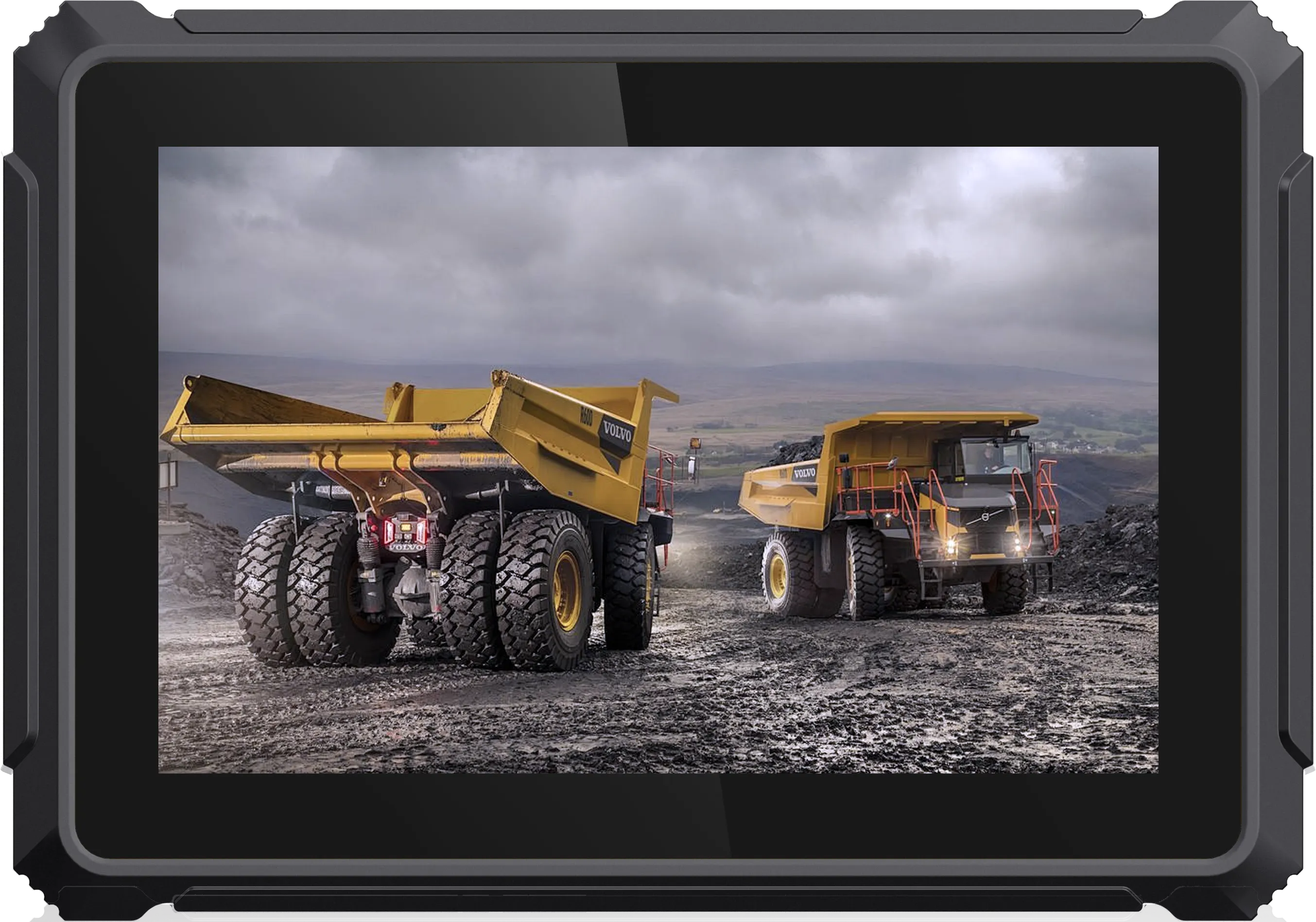
A vehicle is a hostile power supply attached to a paint shaker. The supply dips when the starter motor cranks, spikes when loads dump, and carries the alternator's weather in between. The shaker runs for thousands of hours at frequencies that find every loose connector and tired solder joint. Vehicle-grade terminals are specified against both abuses — a 9-36 V input with ISO 7637-II behaviour for the electrical side, MIL-STD-810 vibration and ISO 16750 shock for the mechanical — and this article explains what each of those lines actually promises, using the PDS T-series specifications as the working example.
None of these specifications photograph well. All of them decide whether the terminal is still working in year three.
The 9-36 V input: one terminal, every fleet voltage
Vehicle fleets run on 12 V and 24 V systems, and mixed fleets run both. A 9-36 V input covers the pair with margin at both ends: the bottom of the range rides through the voltage dip of a cold crank, when a 12 V system can sag toward the single digits, and the top absorbs the charging and transient headroom of a 24 V system. For a fleet buyer the practical gift is standardisation — one terminal model, one harness design and one spare across petrol utility vehicles and diesel trucks alike.
The range also protects the terminal from its own installation. Jump starts, swapped batteries and the general creativity of yard maintenance produce voltages outside the nominal system every year a fleet operates. A terminal specified to 36 V treats those events as weather; a terminal specified tightly to its nominal voltage treats them as warranty claims, and usually loses the argument with physics.
ISO 7637-II: the transient standard behind the voltage line
The voltage range is only half the electrical story; the other half is transients — the fast spikes and dips a vehicle harness generates when inductive loads switch, when a battery disconnects under charge, when the starter engages. ISO 7637-II defines the standard test pulses for exactly that weather on road vehicles, and a terminal specified with ISO 7637-II behaviour has been designed and tested to keep working, or at worst to survive undamaged, through them.
This is the specification that separates vehicle electronics from industrial electronics in a nice enclosure. An industrial panel PC on a vehicle supply may run for months — until the first load dump arrives down the harness. When a datasheet quotes a voltage range with no transient standard beside it, the range describes the terminal's appetite on a bench supply, not on your vehicle. Ask which standard the input was tested against; the answer is the specification.
Vibration and shock: MIL-STD-810 and ISO 16750
Mechanical abuse arrives as two loads. Vibration is the continuous one — engine, road and implement shaking, hour after hour, working on connectors, mounts and solder. Shock is the event load — the pothole, the dropped tailgate, the bucket strike. The T-series specifications address them with MIL-STD-810 vibration testing and ISO 16750 shock testing: the first a broad environmental engineering standard born in military procurement, the second the road-vehicle industry's own environmental conditions standard.
For the buyer, the translation is about failure timing. Vibration failures are rarely immediate; they are the intermittent fault in month fourteen that no bench test reproduces. Terminals tested to recognised profiles, mounted on engineered brackets rather than clamps, and connected with locking vehicle connectors are how fleets buy their way out of that fault class. The mount is part of the rating in practice — the best-tested terminal on a suction cup is a dashcam with ambitions.
Specifying for your fleet's actual weather
Read your own fleet before the datasheets. Diesel or petrol, 12 or 24 V, sprung cab or unsprung machine, road or field — those four answers set the severity the terminal must meet, and they are all knowable today. Then read candidate specifications for the trio: input range with its transient standard, vibration and shock standards named, and the operating temperature range standing beside them (-20 to +70 C across this range). A terminal that names all three, as the T-series datasheets do, is speaking the language of vehicle engineering — and that, more than any single number, is what survives the paint shaker.
Reading a competitor's failure with these specifications
When a vehicle terminal dies young, the autopsy usually names one of this article's three topics. The unit that reboots at every cold start was reading cranking dips below its input floor. The unit that died after a battery swap met a transient its input stage was never tested against. The unit with the intermittent screen fault in month fourteen had been vibrated, one connector fretting cycle at a time, on a mounting that amplified the machine's shake instead of isolating the electronics from it. None of these deaths appear in a features comparison. All of them appear in a specifications comparison — input range and its standard, vibration and shock profiles, and the mounting system standing behind them.
That is the practical use of these unglamorous lines: they are a failure-history document, written in advance. A buyer who learns to read them can predict, model by model, which of the classic deaths a terminal is engineered against and which it is merely hoping to avoid. Hope is not a specification. When the datasheet trio is present and named — 9-36 V with ISO 7637-II, MIL-STD-810 vibration, ISO 16750 shock, as the T-series print them — the maker has at least stood in front of the right tests. The buyer's remaining work is the mounting and harness discipline that lets the tested design deliver its tested life.
Fleet engineers can compress this article into a three-line purchase check. One: input range at least 9-36 V, with ISO 7637-II named, for any terminal that will live on vehicle power. Two: vibration and shock tested to named standards, MIL-STD-810 and ISO 16750 being the pair this industry quotes. Three: an engineered mounting system, fitted as designed, because the tested life assumes it. A candidate that passes all three lines has been built by people who have watched vehicles kill electronics before — and built accordingly.
Key takeaways: Wide-voltage, vibration-resistant terminals
- Cold-start reboots point at the input floor — check the range's bottom
- Transient deaths point at the missing standard — ask for ISO 7637-II
- Intermittent faults point at vibration — and at the mount
- The datasheet trio predicts the classic failure modes
- Mounting and harness discipline complete the tested design
Keep reading after: Wide-voltage, vibration-resistant terminals
Ask about a terminal rated for your vehicles' electrical weather
Send your vehicle, software and interface list. The sales team replies with a configuration and price.