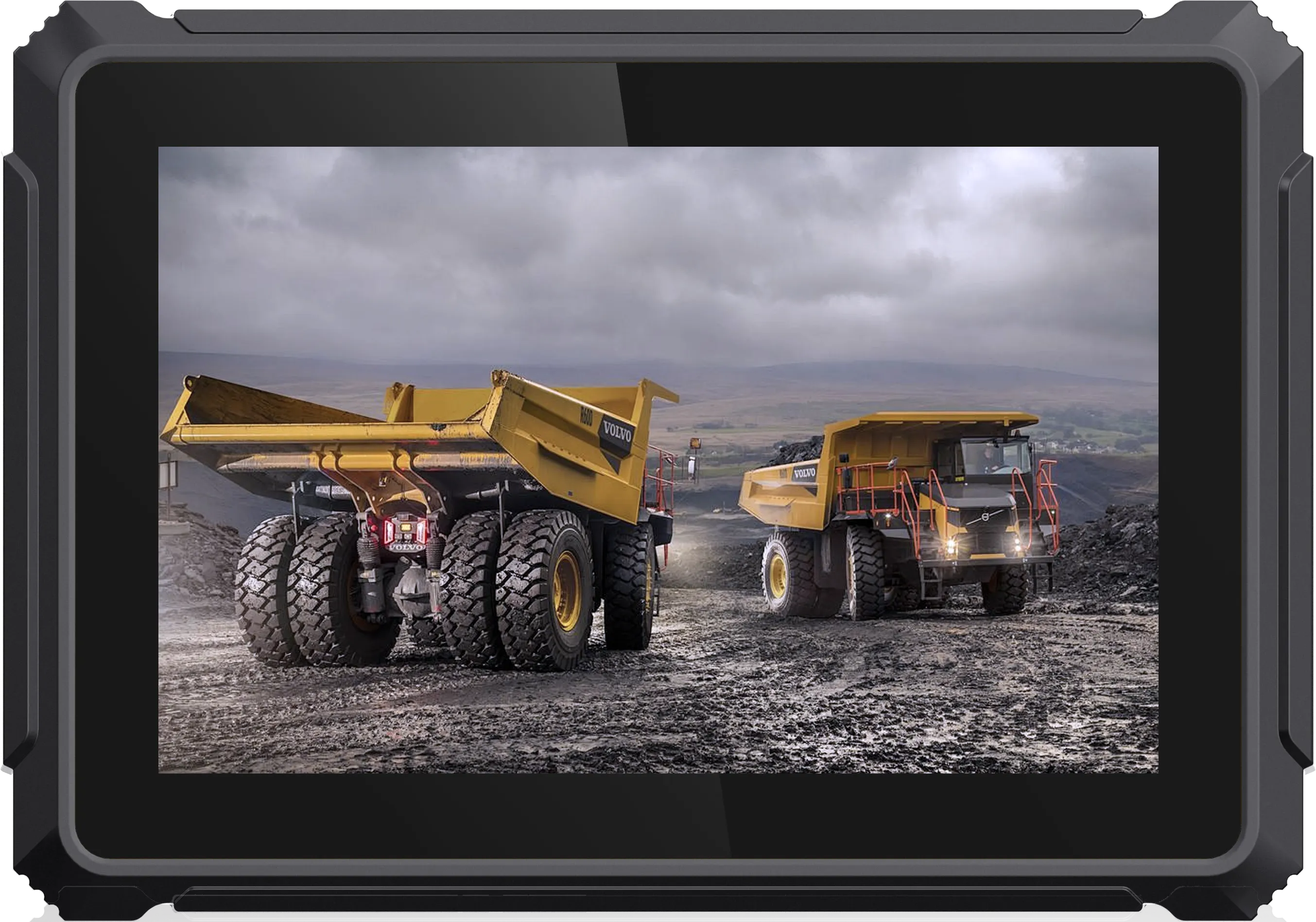
Open-pit mining concentrates every vehicle-computing difficulty into one machine. The truck is enormous, the cab sits atop a ladder of vibration, the dust is abrasive and endless, and the dispatch system — the software that assigns, routes and records every load — treats the cab terminal as production equipment, because it is: a truck with a dead terminal is a truck the system cannot see. The company behind this range describes an 8-inch industrial computer adapted for intelligent dispatch on mining trucks in open-pit work; this guide turns that application into a selection method any fleet can run.
The guide works in the order a mine's own engineers would: duty first, then screen, then connections, then the trial that decides.
Duty first: the environment specification
Mining duty writes its own environmental specification. Sealing must handle fine abrasive dust indefinitely — IP66, dust-tight at the top grade, is the entry point rather than the aspiration. Vibration and shock behaviour must be named against standards — in this range, MIL-STD-810 vibration and ISO 16750 shock — because haul-road corrugations deliver in a week what a highway delivers in a year. Temperature runs from frost starts to cabs baked at solar noon; power must swallow a big diesel's cranking behaviour on a 24 V system, which the range's 9-36 V input with ISO 7637-II behaviour is designed to do.
Anything missing from that list is not a saving; it is a maintenance programme. Mines feel the difference between consumer-adjacent hardware and vehicle hardware in the first quarter, in downtime denominations.
Screen and platform for dispatch work
The dispatch terminal's screen serves two masters: the driver, who needs assignment, route and status at a glance over rough ground; and the system, which needs the terminal awake, located and reporting. Eight inches is the compact-cab answer and the size the company presents in its mining dispatch material — the T8 for the standard expansion set, the T8 Pro where camera recording joins the requirement. Larger trucks with room and a richer dispatch display can step up to the 10.1-inch models, whose larger screens carry map-heavy clients more comfortably — though the company's published dispatch case itself is built on its 8-inch models.
Platform choice follows the dispatch software. Most mine dispatch and fleet systems offer an Android client, which the range covers from Android 10 to 13; where the mine's integrator builds its own stack, the Linux builds on the T10B and its siblings are the candidates. Boot behaviour matters underground and at shift change alike: the terminal should return to the dispatch screen, not to a launcher, every time the key turns.
Connections: cameras, positioning and the truck's own data
Mining trucks justify camera channels like few other vehicles — blind spots measured in metres, reversing over benches, loading under excavators. Plan the camera set as part of the terminal selection: viewing channels for the driver, recording channels where the operation's safety case demands evidence, with the Pro models' four simultaneous recording channels as the range's ceiling. Positioning is the second connection: standard GNSS serves dispatch location, while operations running guidance or precision dumping join the RTK conversation covered elsewhere on this blog.
The truck's data bus is the third. CAN access lets the terminal read machine state for the dispatch and maintenance systems rather than merely carrying a screen. Count the channels against the truck's architecture, confirm the expansion combination for the exact build, and put the harness on paper before the order — retrofit wiring in a mine workshop queue is measured in shifts, not hours.
The trial that decides it
Mining selection ends the way mining does everything: with a trial on the real fleet. Fit one truck, on the worst route, with the full configuration — mount, harness, cameras, dispatch client — and run it through a maintenance cycle. Judge four things: screen legibility in pit glare, mount survival on corrugations, dispatch uptime across shift changes, and connector behaviour after wash-down. A terminal that passes a month of that has passed the only review committee whose opinion moves production.
Then scale with discipline: same configuration, same harness design, same software image across the fleet, so that the second hundred terminals install like the trial unit did. In mining, standardisation is not bureaucracy — it is how uptime is manufactured.
What the first month of a mining trial usually reveals
Mining trials earn their keep in the second week, when the new-equipment glow fades and the truck rejoins the fleet's real rhythm. The revelations are rarely electronic. The mount that was fine on the test pad develops a buzz at the corrugation frequency of the main ramp. The screen that read well at noon washes out at the shift-change hour when the pit wall throws reflected light. The camera aimed on the workshop floor points at sky once the truck is loaded and the suspension settles. The dispatch client that behaved on office WiFi sulks on the pit network's roaming edges. Every one of these is fixable in a trial and expensive in a fleet — which is the entire economic argument for trialling on the worst truck and the worst route rather than the best.
The trial should therefore be specified like a test, not a demonstration: named truck, named route, full production configuration, a maintenance cycle elapsed, and four pass marks written down before it starts — legibility in pit glare, mount behaviour on corrugations, dispatch uptime across shift changes, and connector and seal behaviour after wash-down. Judge against the marks, fix what fails while the fix is one truck wide, and only then let the configuration harden into the fleet standard. Mining rewards that discipline with the only currency it respects: trucks the system can always see.
A final selection note on standardisation across the pit: mines run mixed fleets bought across decades, and the temptation is to fit each truck model with its own best terminal. Resist beyond cab-fit necessity. One terminal family across the haul fleet means one harness design, one software image, one spare pool and one training story for operators who change trucks between shifts. The dispatch system sees a uniform fleet, maintenance holds uniform parts, and the trial's lessons apply to every truck instead of a lucky few. In an environment priced by the hour of downtime, uniformity is a production decision, not an aesthetic one.
Key takeaways: Vehicle computers for mining trucks
- Trial on the worst truck and the worst route, not the best
- Write the four pass marks down before the trial starts
- Loaded suspension changes camera geometry — aim loaded
- Pit network roaming is part of the dispatch test
- Fix trial findings while they are one truck wide
Keep reading after: Vehicle computers for mining trucks
Ask about a dispatch terminal trial for your haul fleet
Send your vehicle, software and interface list. The sales team replies with a configuration and price.