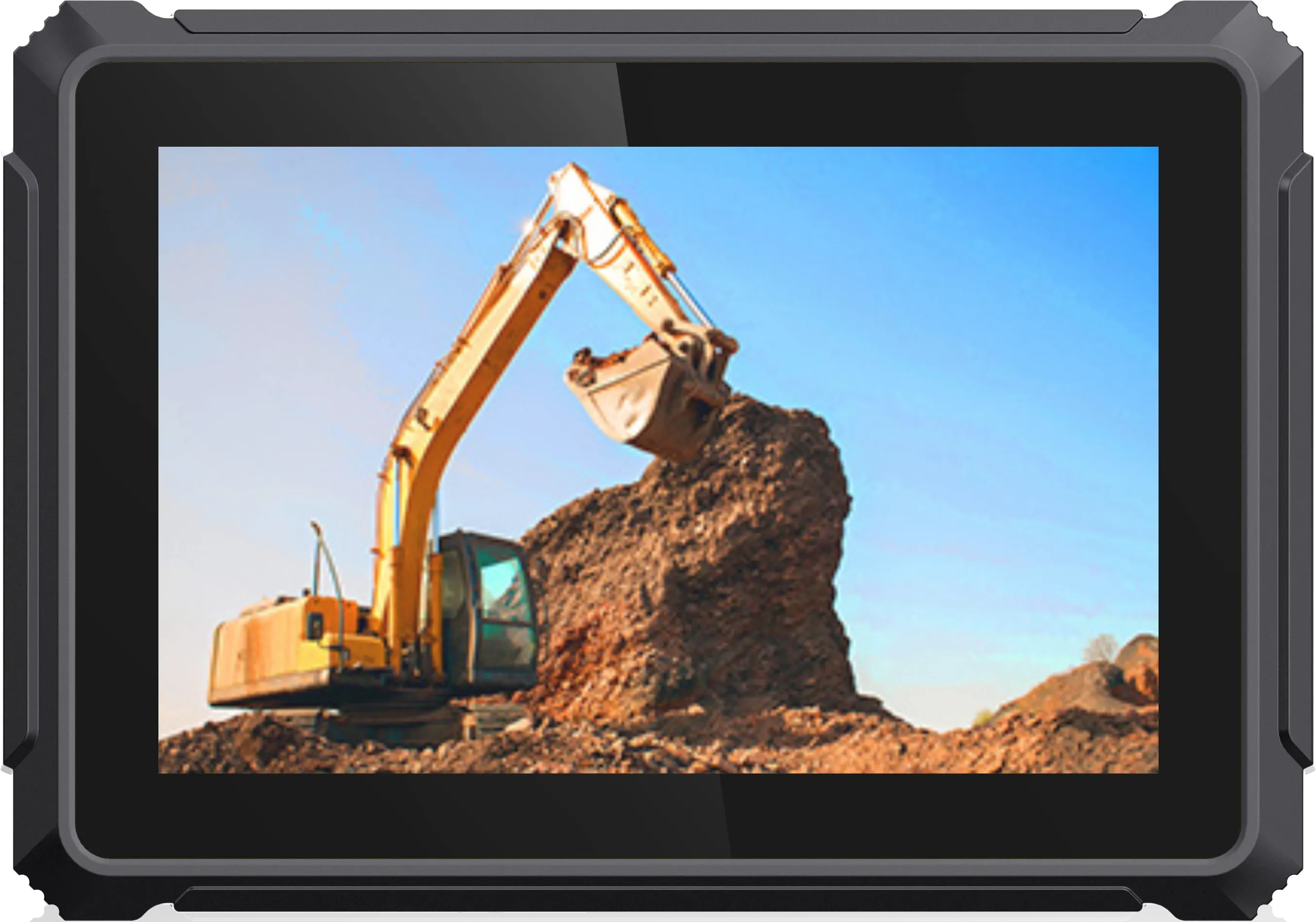
Every vehicle terminal works in the morning. The test comes at midday in an open field or a white gravel yard, when the sun turns the cab into a light box and the guidance screen washes to grey. Sunlight readability decides whether the operator drives by the terminal or despite it — and it is produced by a combination of specification lines that buyers often read in isolation. This article separates the contributors: panel brightness, optical bonding, contrast behaviour and the mounting decisions that no specification can rescue.
Across the PDS mounted range the shared baseline is an IPS panel at 750 cd/m2 or brighter, fully laminated, with multi-touch. That baseline is a good lens for the discussion, because it shows which parts of readability are bought in the panel and which are earned in the installation.
Brightness: the entry ticket, not the whole game
Brightness, quoted in cd/m2 (nits), is the panel's light output against the sun's. Office screens live around 250-350 nits and die outdoors; vehicle panels start earning their keep around 700 and the range here is specified at 750 or higher. Brightness buys contrast in ambient light: the brighter the emitted image relative to reflected sunlight, the more of the interface survives. It is a threshold specification — below it, nothing else matters; above it, other factors take over.
Brightness also costs. Higher output means more heat inside a sealed housing and more draw on the vehicle supply, which is why honest vehicle terminals cluster in the 700-1000 nit band rather than chasing phone-style peaks. A datasheet claiming extreme brightness from a fanless sealed unit deserves a question about sustained output on a hot day, when the panel, the sun and the cab all peak together.
Lamination: the reflection killer
The second contributor is construction. A fully laminated (optically bonded) display fills the gap between the touch layer and the LCD with resin, removing the internal air surfaces where reflections form. The visible effect is not subtle: blacks stay black in sun, contrast survives at oblique angles, and the image appears printed on the glass rather than floating behind it. In this range, full lamination is specified across the mounted line, and it is the single feature drivers notice most when a bonded terminal replaces an unbonded one in the same cab.
Bonding carries secondary wins for vehicle duty. The bonded stack is mechanically stronger, resists the condensation that fogs unbonded displays on cold mornings, and keeps dust out of the display sandwich permanently. When a supplier's datasheet is silent on lamination, assume the air gap is there and budget the readability loss into your comparison.
Contrast, coatings and content
Readability is finished by surface and software. Anti-glare surface treatments scatter reflections instead of mirroring them; interface design decides the rest. Thin grey text on a photographic background fails at noon on any panel; bold lines, high-contrast symbology and large touch targets survive. Guidance and dispatch software built for vehicles already follows those rules — which is one more reason the terminal and the software should be chosen as a pair, and trialled together, in sun, before a fleet order.
Viewing angle is the quiet fourth factor. IPS panels hold colour and contrast across wide angles — the T7's specification quotes a viewing angle of 170 degrees or wider — and cab terminals are rarely viewed square-on. A panel that reads beautifully from the driver's eyes and washes out from half a metre to the side will generate complaints that sound like brightness problems and are actually angle problems.
Mounting: the readability decision made with a bracket
The final contributor is geometry. A screen tilted to reflect the windscreen or the driver's own bright shirt loses to physics regardless of specification. Good installations angle the panel toward the driver's eyes, shade it with the cab's own structure where possible, and place it outside the direct sun path through the glass across the working day — a path that moves, which is why a ten-minute sit-in at noon beats an hour of datasheet comparison.
Specify the panel properly — brightness at the vehicle grade, full lamination, IPS angles — then mount it like you mean it. Sunlight readability is delivered by the combination, and fleets that treat it as a system stop hearing the oldest complaint in vehicle computing: that the screen cannot be read when the work is brightest.
Testing readability the way the sun will
There is a five-minute test that predicts a season of readability complaints: take the candidate terminal, powered, running the actual application, into the actual vehicle at midday. Sit in the driver's seat. Work the screen the way the job works it — glance at the guidance line, read a rate, find the camera view. Then turn the vehicle ninety degrees and do it again, because the sun moves and the second heading is the one that finds the reflection geometry the first heading forgave. If the screen survives both headings with the standard mount position, readability is solved; if it fails, no datasheet adjective will save it in August.
The test also separates the specification's contributors in practice. A dim panel fails everywhere at once. An unbonded panel fails by reflection — the image present but veiled. A poor-angle panel fails from the passenger side of the driver's natural view. Each failure has a different remedy and a different price, which is why the trial matters more than the argument: it tells you which problem you actually have. Fleets that run the midday test on one vehicle per model, before the fleet order, stop having readability conversations entirely — the sun has already given the review that counts.
There is also a fleet-level dividend to solving readability properly: it ends a category of dispute. When screens wash out, drivers improvise — shading with a hand, twisting the mount, abandoning the terminal for a phone — and every improvisation is a small safety and data-quality debt. A readable terminal removes the improvisation market entirely. That is why experienced fleet engineers treat the brightness, lamination and angle lines as safety specifications rather than comfort features, and why the midday trial, cheap as it is, appears in their procurement process as a formal gate.
Key takeaways: Sunlight-readable vehicle computers
- Brightness is the entry ticket; lamination kills the reflections
- IPS viewing angles decide off-centre readability
- Test at midday, in the vehicle, on two headings
- Diagnose the failure type before paying to fix it
- Mounting angle is a readability specification too
Keep reading after: Sunlight-readable vehicle computers
Ask about a screen your operators can read at noon
Send your vehicle, software and interface list. The sales team replies with a configuration and price.