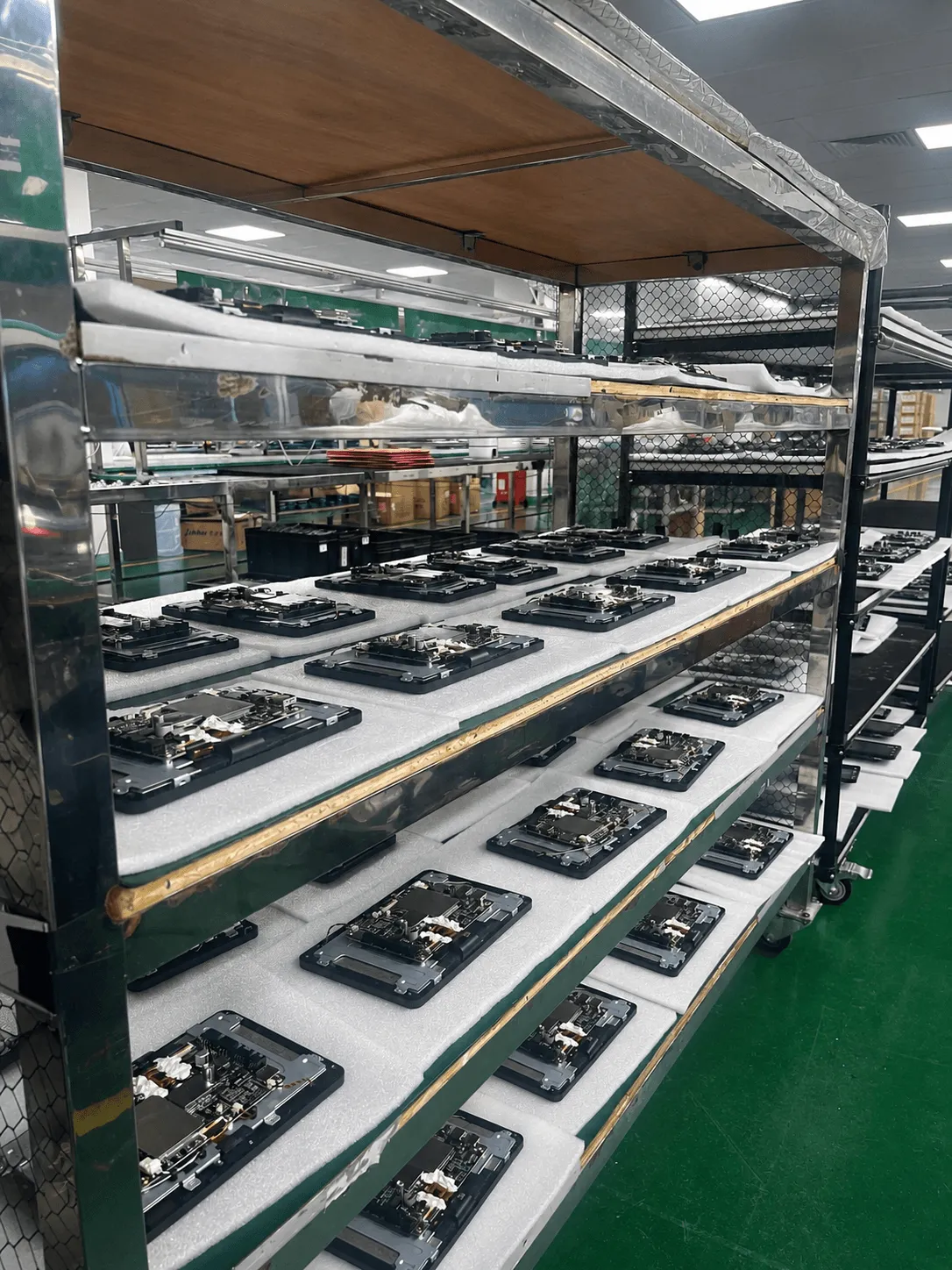
Every rugged terminal datasheet carries an IP rating, and IP66 has become the vehicle industry's default claim. It is a genuinely useful certification — when it is read properly. Read carelessly, it becomes a spell buyers cast against all environmental risk, including risks it never covered. This article reads the code digit by digit, places it beside the other environmental specifications that actually share the work, and ends with the installation habits that decide whether a rating survives contact with a real fleet.
The examples come from the PDS T-series, whose models each list IP66 in their published specifications — but the code belongs to the IEC standard, not to any maker, and the reading applies to every datasheet on your desk.
Digit one: the dust grade that runs your fleet's calendar
The first digit grades solid-particle protection, and 6 is its ceiling: dust-tight, no ingress of dust, established in a dust chamber test. For a vehicle terminal this is the digit that compounds. Dust is not an event, it is a climate — harvest chaff, quarry fines, construction powder and road grit work on every seam, connector and cooling path for the life of the machine. An unsealed or lightly sealed terminal does not fail in the first dusty week; it fails in the third season, as conductive dust and moisture conspire inside a housing that was never designed to keep them out.
Dust-tight also changes the thermal design. A sealed housing cannot breathe, so the terminal must shed processor heat through its case — one reason vehicle terminals are built as metal-backed slabs rather than vented boxes. When you compare two IP66 claims, the housing construction photos tell you more than the digits do.
Digit two: water jets, pressure washing and driven rain
The second digit grades liquid protection, and 6 certifies protection against powerful water jets from any direction — in test terms, a strong jet nozzle at close range. Translated to the yard: pressure washing the machine with the terminal mounted, driven rain at highway speed, and wash-down in food-adjacent and agricultural work. That is precisely the water exposure vehicles actually meet, which is why the grade fits the industry so well.
What digit 6 does not certify matters equally. It is not immersion (that begins at 7 and 8), it is not steam cleaning, and it says nothing about chemicals — fertiliser, hydraulic oil and cleaning agents attack seals and screens through chemistry, not pressure. A terminal that will be steam-cleaned or soaked needs a different conversation, and a datasheet that lets you believe IP66 covers those cases is doing you a disservice you will pay for later.
The ratings that share the work
No terminal survives on sealing alone. Vibration is the second environmental killer, addressed in this range by MIL-STD-810 testing named in the specifications; shock by ISO 16750; temperature by a -20 to +70 C operating range that covers frost starts and sun-baked cabs; and electrical abuse by a 9-36 V input with ISO 7637-II behaviour that rides out cranking dips and load dumps. Read as a set, those lines describe a machine environment. Read as a single IP number, they describe a rain test.
Documentation deserves the same set-based reading. The company's published gallery for the T10 family includes an IP66 test report among its certificate images, alongside E-Mark and CE material and shock and vibration reports. The professional habit is to ask for the current test and certificate copies for the exact model and configuration you are buying — paperwork ages, configurations change, and the report that covers your build is the only one that counts.
Installation: where ratings go to die
An IP66 terminal can be installed down to IP-nothing by small acts: a connector left unmated with its port open, a cable gland substituted, a bracket drilled through the housing, a seal pinched during a rushed refit. Fleets that keep their ratings share habits — connectors mated or capped, cables routed with drip loops, housings opened only on the bench, and a wash-bay rule that jets avoid direct close-range hits on connector panels despite the rating, because seals age.
Specify honestly and install carefully, and IP66 is exactly enough for the work vehicles do. That is the unglamorous truth the datasheet's two digits are trying to tell you: dust kept out completely, water jets shrugged off, and the rest of the environment handled by the ratings and habits standing next to them.
A wash-bay story, and the specification habit it teaches
A fleet manager once traced a season of intermittent terminal faults to a single habit: the wash crew, proud of clean machines, held the pressure lance close to the connector panel at every wash. The terminals were honestly IP66 — the rating covers powerful jets, and the seals were not lying. But seals age, connectors get opened and refitted, and a lance at twenty centimetres delivers a punishment closer to a test-rig extreme than to weather. The fix cost nothing: a wash rule that kept the lance at a respectful distance from electronics, and the faults retired with the habit. The rating had not failed; the reading of it had. IP66 certifies resistance to a defined test, not immunity to a determined human with a pressure washer and time.
That is the habit this whole topic teaches: treat every environmental specification as a tested envelope with edges, and manage the edges. Keep connectors mated or capped. Route cables with drip loops so water runs off, not in. Open housings on the bench, not in the yard. Re-inspect seals when a terminal is refitted. And when a workplace genuinely exceeds the envelope — steam cleaning, chemical wash, immersion risk — say so in the enquiry and specify for it, rather than discovering at the first failure that the two digits were asked to cover a world they never claimed to.
Buyers comparing two IP66 terminals should spend their remaining questions on the edges of the envelope: the connector system's sealing when mated and when capped, the screen's chemical resistance against the agents their workplace actually uses, and the maker's test paperwork for the specific model. Those three answers separate two identical IP66 claims into a suitable terminal and a gamble. The digits get a model onto the shortlist; the edges decide whether it should stay there after the first wash season.
Key takeaways: What IP66 means for a vehicle computer
- IP66: dust-tight completely; powerful water jets, not immersion or steam
- Ratings are tested envelopes — manage the edges in installation
- Connectors mated or capped; cables with drip loops
- Ask for current test copies for your exact configuration
- Describe chemical and steam exposure honestly when you enquire
Keep reading after: What IP66 means for a vehicle computer
Ask about a sealed terminal for your working conditions
Send your vehicle, software and interface list. The sales team replies with a configuration and price.